In 2025, at least 97 children and young adults with autism were recovered deceased after eloping, and 84 deaths were due to drowning.
A caregiver calls 911. A child with autism slips away while getting ready for school, during a birthday party, or after moving to a new apartment. Within moments, the call-taker identifies an urgent situation: this missing child is at extreme risk of drowning. Now imagine that, within minutes, the immediate neighborhood receives a community notification on their phones with one clear instruction: SEARCH WATER NOW.
This powerful approach is within reach. The National Center for Missing & Exploited Children (NCMEC), in collaboration with the National Autism Safety Council (NASC), is recommending a new approach to tools already available to public safety so we can strengthen the first minutes of response for the highest-risk missing children with autism. To prevent drowning after someone with autism elopes, the action of a few nearby people can be more powerful than the awareness of thousands.
For most of my career at NCMEC, I’ve supported the AMBER Alert program. This includes facilitating different amplification technologies, working with emergency alert stakeholders, and examining every AMBER Alert incident in detail to identify trends and needs. The topic of drowning and autism has always been adjacent to this work, because the core question is so similar to what led to AMBER Alerts: can the community aid in the rescue of missing children?
Broadcast to Beacon: Scaling Alerts for Rescue
Thirty years ago, after the abduction and murder of Amber Hagerman, an audacious idea changed child protection by proposing an answer: use emergency communication tools to enlist the public in the search for an abducted child. AMBER Alerts became the global standard and are built on a “see something, say something” model of communication where each activation is sent to all available technology to generate awareness and leads for law enforcement. When someone is moving with a child and intends harm, witnesses may be anywhere.
How can we apply that success to decrease fatalities after elopement? It is natural to think all alert messages for missing persons would have the same impact but, in practice, mass communication produces vastly different community action depending on content, target area, and timing. Emergency communication relies on simple, instructive messages to prompt action without delay. Understanding the circumstances surrounding elopement and drowning is integral to identifying what a community notification needs to achieve.
In close collaboration with the NASC, my team examined hundreds of incidents and built on years of tracking led by NASC founder Lori McIlwain. The distance, movement, and outcome are alarmingly predictable. We know that:
1. Most drownings occur less than ½ mile from where someone was last seen.
2. Water entry happens quickly, often within minutes.
3. These events disproportionately involve young children under age 10.
4. Someone who is nonspeaking, has IDD, or higher support needs is at higher risk.
5. Drowning is the most likely hazard for certain individuals.
When a child with autism elopes, water entry is happening in a few minutes and within a few hundred feet. We must move beyond awareness to geographically precise, action-oriented communication that prompts individuals to check and monitor water sources nearby.
Wireless Emergency Alert (WEA) cell phone messages are designed to do just that. The “Big A” alerting model of AMBER Alerts is far too broad when the hazard is likely within walking distance. Advocates, dispatch leaders, emergency managers, and missing persons alert professionals have long supported some local use of WEA. In fact, some states issue targeted WEA messages when autism is a factor, but time remains an obstacle.
Instead, consider local activation for local action. In the spirit of Reverse 911, which used landline phones, WEA can reach people in and around the limited search area with simple instructions. Sending a simple message right away increases the odds of a rescue and doesn’t preclude other alerts or messages that may be needed later.
The MEP Event Code and the Path Forward
Why now? We are at a tipping point: a convergence of public sentiment, technology, and understanding. WEA messages became available in 2012 as a powerful communication tool. Crafted for emergency alerts, including AMBER Alerts, they were somewhat intimidating, and sending them locally for missing persons wasn’t fully conceptualized yet. Until recently, non-AMBER messages often felt like a workaround. Their use wasn’t prohibited, but it also wasn’t explicitly encouraged.
In 2024, the FCC approved the Missing and Endangered Persons (MEP) event code for emergency alerts, reflecting the work of the Not Invisible Act Commission and Native Public Media. While WEA handling and functionality remains unchanged, the MEP pathway broadens access by establishing a recognized, practical route for cases that do not meet AMBER Alert criteria. This shift reflects a national commitment to more inclusive missing person response and makes WEA a more attainable and appropriately applied tool in autism elopement scenarios. As public familiarity with wireless alerts continues to grow, the MEP categorization further validates the use of WEA for a wider range of urgent missing person cases.
In early 2025, as MEP availability neared, I reviewed WEA messages used for non-AMBER Alert missing people and found that, when a rare autism-related message is sent out, water was almost never mentioned. The clear need for guidance sent me back to the people who had been closest to this reality for years. With mentorship from Lori McIlwain and other experts, operational recommendations and criteria took shape. The goal was simple: using clear, inclusionary criteria to trigger effective response so someone might get to a missing person before they drown.
WEA: Words as a Lifeline
Let’s go back to the scenario at the beginning. Picture the search radius of a mile around where the child was last seen. Inside that circle are an unknown number of water sources and the unaware community. Outside of the circle are first responders, drones, and K-9 units but it takes time to converge. The need is twofold: get professionals moving toward the right location as quickly as possible and inform the people who are already there so they can help. WEA can meet that second need but only if the message is trusted, understandable, and complete.
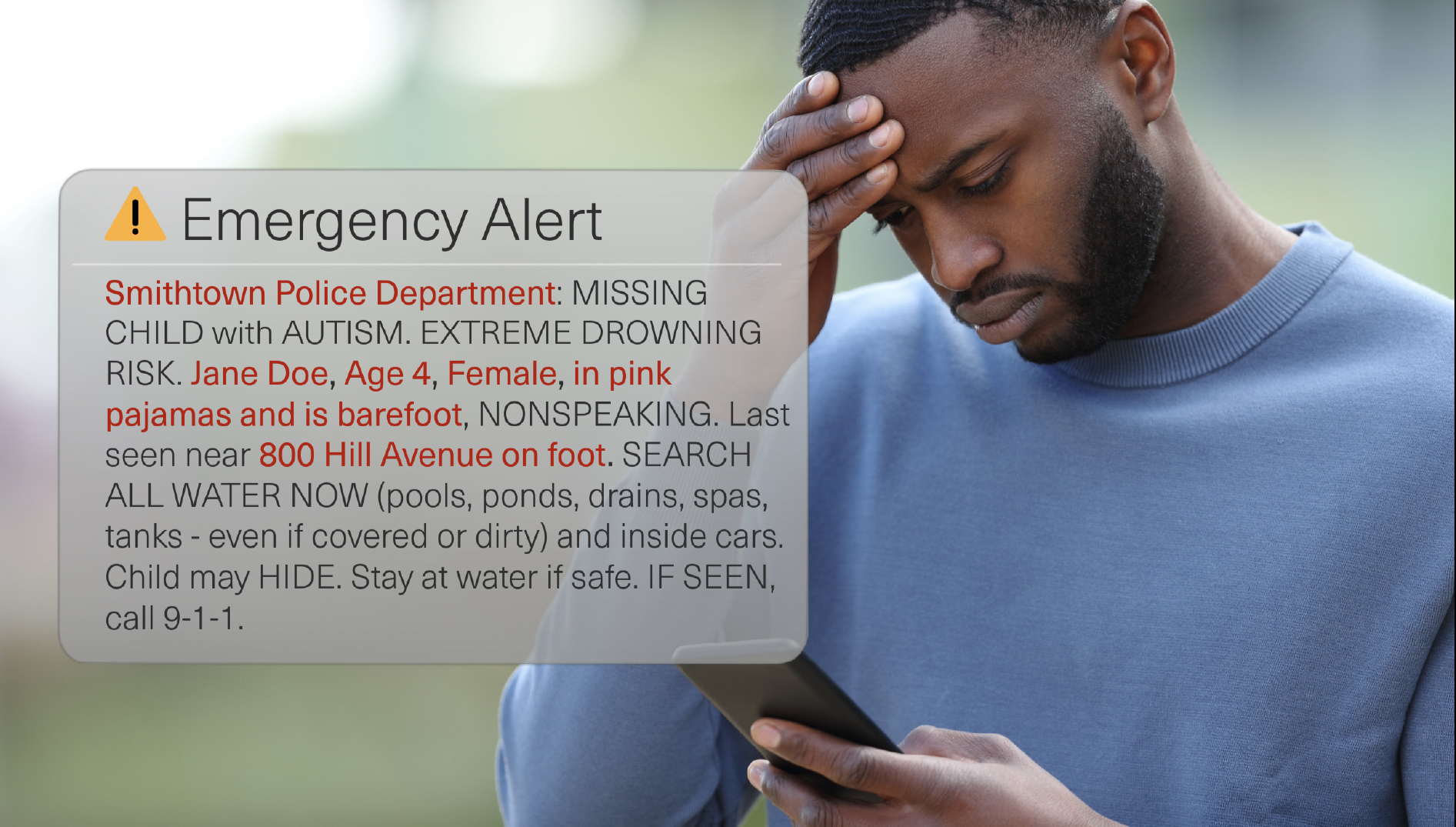
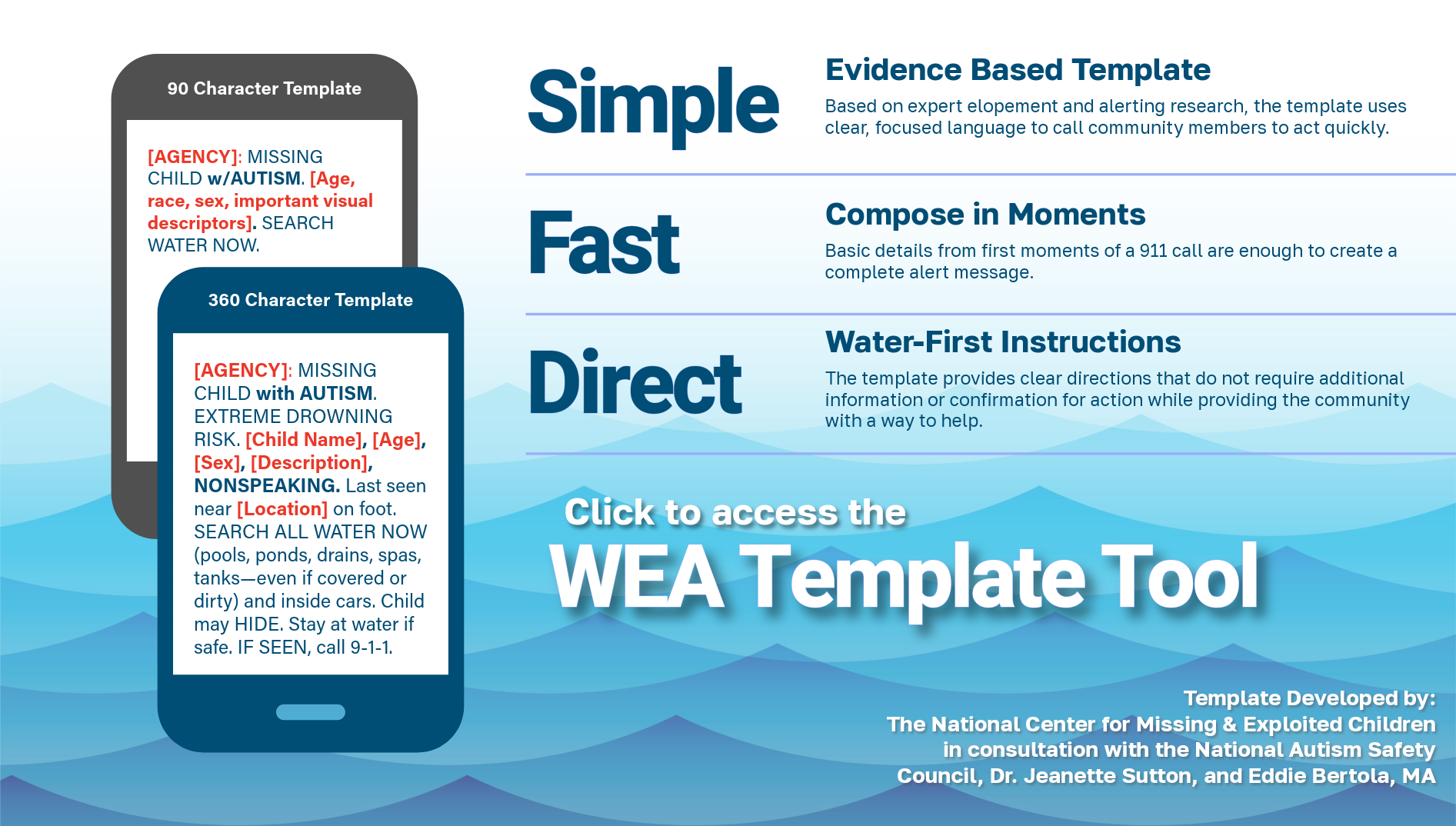
Enter Dr. Jeanette Sutton and my longtime colleague and Missing Person Alert expert, Eddie Bertola, who helped us craft a template message and start to work through the complexities. The result is a simple template that can be filled out with minimal information and sent 1–3 miles around the last-seen location. While a dispatcher may be tasked with deploying the message, this template removes game-time decisions. When a missing person falls into a drowning-risk category, they can fill out five objective items of information, select the radius center, and send.
To Local Public Safety Leaders
WEA as the first action during a missing child event is a massive operational shift. Can you navigate policy and invite your colleagues to incorporate rapid, water-focused WEA messages into your protocols? It’s not as simple as telling 911 centers they should send WEA messages; implementation must account for existing policies to ensure the safest and most effective use. Once the community is called to action, it is imperative that this message is just the start, so they know when to stand down, where else to search, and when to celebrate a rescue.
Local adoption will happen through daring and creative leaders in public safety. A sustainable approach will include law enforcement and all other first responders in the plan. Decades of emergency alerting have shown that speed comes from simplicity, so each jurisdiction will need to remove layers of approval and streamline every process to trim out every extra second through careful preparation. You must be ready to instruct everyday folks in moments, under stress, and with imperfect information. Your willingness to take on this challenge will save lives.
To get started, reach out to your state AMBER Alert coordinator, learn about the Integrated Public Alert and Warning System, or email autism@ncmec.org. Even if use of WEA may be far off, there are actions you can take now:
- Use the template: The WEA template provided here reflects intentional, evidence-based formatting and language to prompt action. If you have a path to WEA activation, use this template to save precious minutes.
- WEA may be available now. Talk with your Emergency Management Agency about how WEA is activated today and what a rapid process for extreme drowning risk would require. Trading cell phone numbers is a great start!
- Review your current policy. Take a look at what options you have available in writing, not just based on handshake deals or word of mouth. See if you need additional permissions to do this or if you already have the green light.
- Use what you have today. Use other local communication options and keep the language consistent. Reuse the same action-focused wording from the WEA template in community texts and neighborhood platforms so people learn what to do when seconds matter.
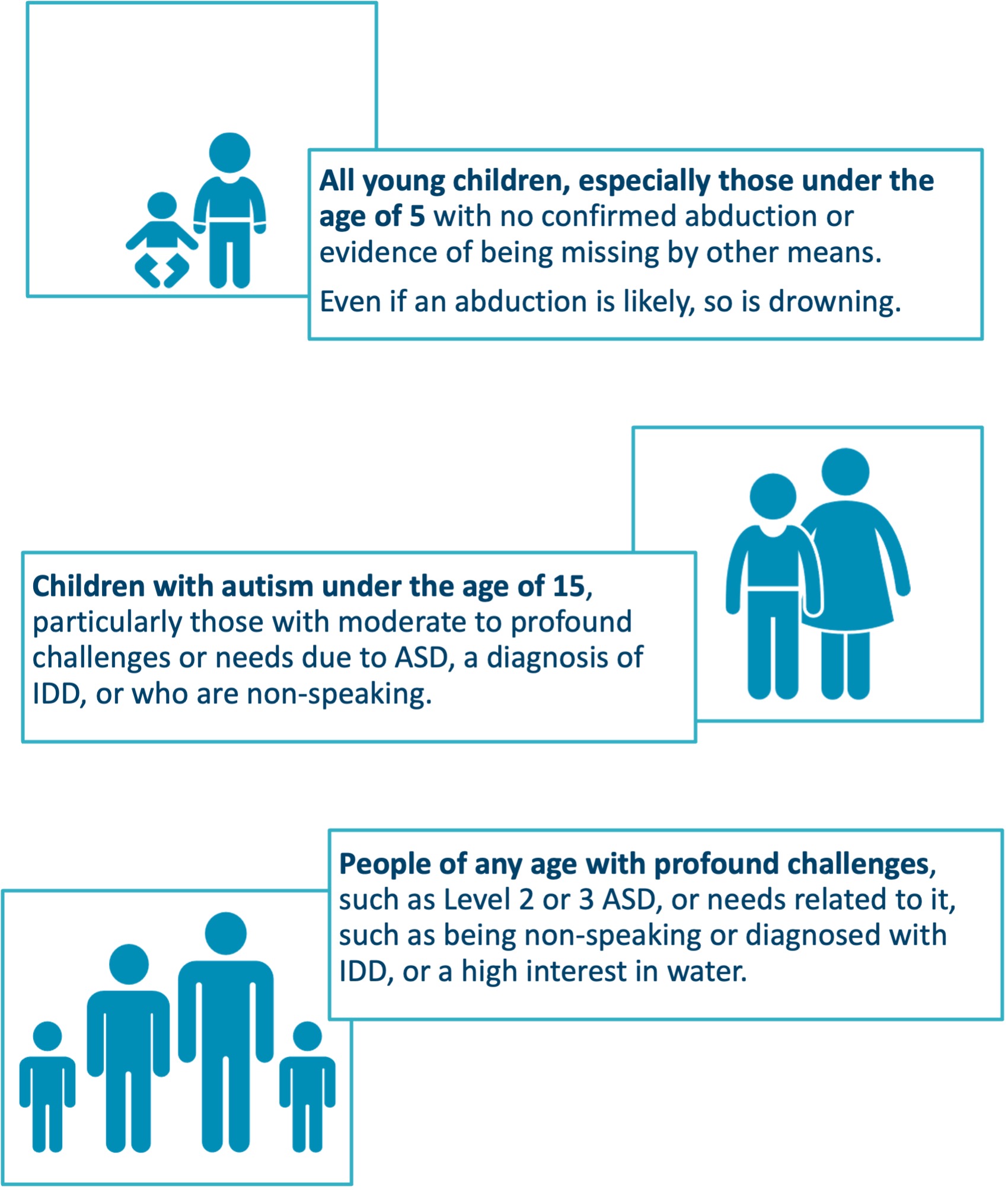
- Build for speed. Pre-identify nearby water hazards in dispatch tools, streamline risk assessment using the risk groups in the Search Water First module, and work with autism families in your community on prevention and preparation.
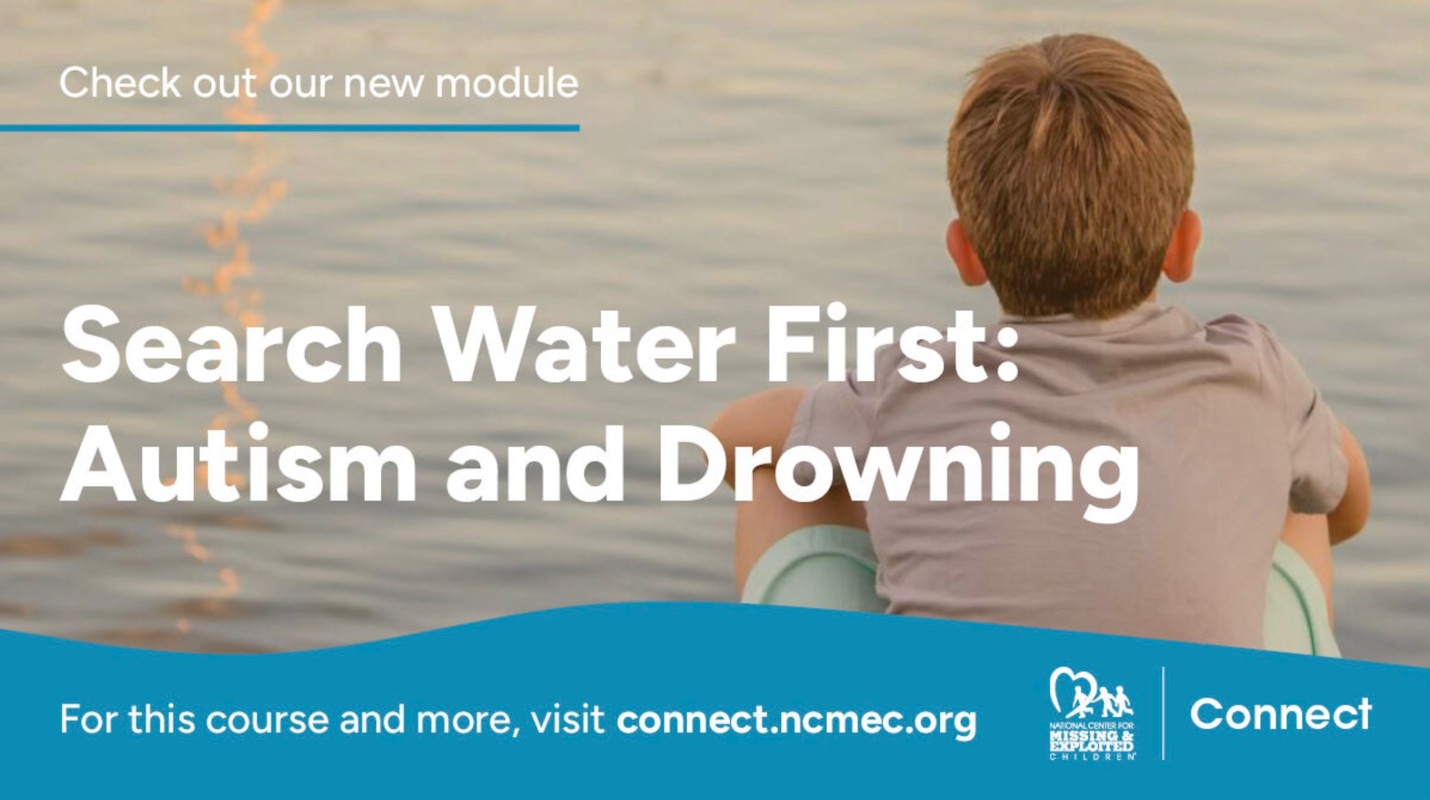
- Understand the need. Update training and ask potential stakeholders to take the Search Water First learning module – it’s just 12 minutes of time.
One Step in the Right Direction
This will not replace layers of safety, prevention, or a full autism response plan. It adds a community notification layer for the first minutes, when proximity matters most and until responders are fully deployed. It is also just one powerful addition to a water-first response plan, which is why NCMEC and NASC are collaborating to build out a range of actionable recommendations for public safety for that critical first 10 minutes.